


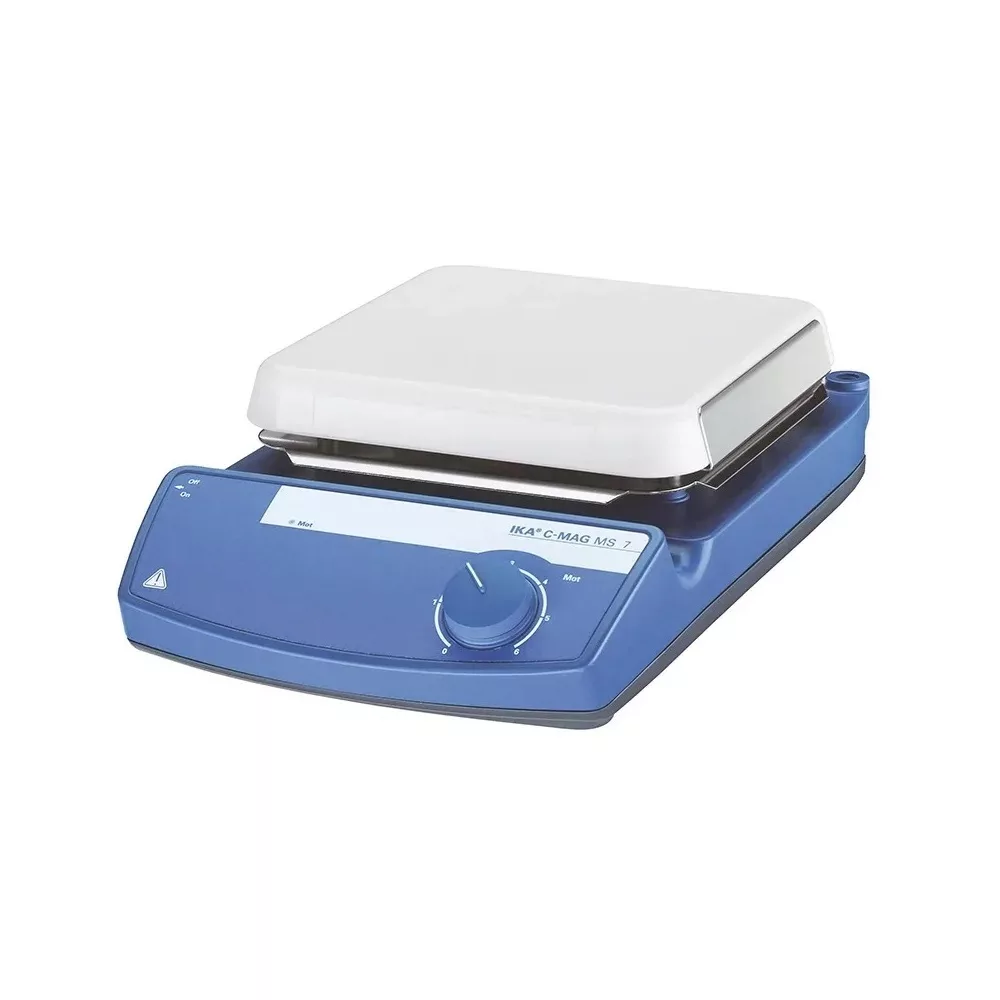

Magnetic Stirrer: Efficient, Reliable, and Hands-Free Mixing for Modern Laboratories
Magnetic Stirrer IKA C-MAG MS 7 is a fundamental laboratory instrument designed to provide consistent and controlled mixing of liquid solutions using a magnetic field and a rotating stir bar. Whether used in chemistry labs, pharmaceuticals, environmental testing, academic research, or food and beverage analysis, magnetic stirrers ensure uniform mixing with minimal manual intervention. Known for their simplicity, durability, and efficiency, these instruments are essential for preparing solutions, dissolving solids, and maintaining reaction uniformity.
In this comprehensive guide, we explore what a magnetic stirrer is, its key features, applications, and the advantages it brings to laboratory workflows.
What is a Magnetic Stirrer?
A magnetic stirrer is a device that uses a rotating magnetic field to spin a magnetic stir bar placed inside a container, mixing the liquid without direct mechanical contact. The system typically consists of:
-
A motor or magnetic drive that generates rotation
-
A magnetic stir bar (flea bar) coated with chemically resistant PTFE
-
A flat platform for beakers, flasks, or reaction vessels
Unlike manual stirring or overhead mechanical stirrers, magnetic stirrers offer quiet operation, minimal contamination risk, and the ability to mix sealed or sterile containers without direct contact.
Key Features of a Magnetic Stirrer
1. Quiet, Hands-Free Mixing
Magnetic stirrers provide smooth and silent stirring, allowing precise mixing without physical contact with the sample. This reduces contamination risk and simplifies workflow.
2. Adjustable Speed Control
Most magnetic stirrers offer variable speed settings, allowing users to fine-tune the vortex based on sample viscosity, volume, or reaction needs.
3. Hot Plate Compatibility (Heating Stirrers)
Many magnetic stirrers come with integrated heating plates that allow simultaneous mixing and heating. This is essential for:
-
Dissolving solids faster
-
Conducting temperature-dependent reactions
-
Maintaining stable reaction conditions
4. Chemical-Resistant Plates & Surfaces
The top plates are often made from ceramic, aluminum, or stainless steel, offering:
-
High temperature resistance
-
Chemical durability
-
Easy cleaning
5. Compact & Portable Design
Magnetic stirrers are lightweight and available in multiple sizes, from mini stirrers for small bench work to larger units for industrial volumes.
6. Timer & Programmable Features
Advanced models allow:
-
Pre-set mixing times
-
Ramp-up speed control
-
Automated start/stop sequences
These features improve consistency and reduce manual oversight.
7. Multiple Stirring Positions
Some magnetic stirrers offer multi-position platforms, enabling simultaneous mixing of multiple samples—ideal for QC labs and research facilities.
Applications of Magnetic Stirrers
1. Chemical Laboratories
Used for preparing standard solutions, dissolving reagents, and maintaining uniform reaction mixtures. Magnetic stirrers are indispensable for titration, buffer preparation, and general mixing.
2. Pharmaceutical Industry
Supports drug formulation, sample preparation, dissolution testing, and quality control. The ability to mix sealed containers helps maintain sterile conditions.
3. Food & Beverage Testing
Magnetic stirrers are used for mixing ingredients, dissolving flavor agents, homogenizing samples, and conducting chemical quality control tests.
4. Environmental & Water Testing
Ideal for sample homogenization, water quality analysis, reagent dissolution, and preparing calibration standards.
5. Academic & Research Institutions
Magnetic stirrers support chemistry, biology, biochemistry, and materials science labs where consistent and repeatable mixing is essential for experimental accuracy.
Benefits of Using a Magnetic Stirrer
1. Clean and Contamination-Free Mixing
Since the only component in contact with the sample is the stir bar, the risk of contamination is low—making it ideal for sterile and sensitive applications.
2. Efficient & Consistent Mixing
Magnetic stirrers provide uniform mixing across long durations, ensuring stable and reproducible results.
3. Minimal Maintenance
With no mechanical parts inside the sample, magnetic stirrers require little maintenance compared to overhead stirrers.
4. Improved Workflow & Ease of Use
Simple controls and hands-free operation allow technicians to focus on other tasks while maintaining controlled mixing.
5. Versatility in Sample Handling
Compatible with various vessel types, including beakers, Erlenmeyer flasks, test tubes, and reactors, magnetic stirrers can handle both small and large volumes.
How to Choose the Right Magnetic Stirrer
1. Stirring Volume Requirements
Different models support volumes from a few milliliters to over 20 liters. Choose based on your typical workflow.
2. Heating Needs
Decide whether you need a basic stirrer or a hot plate stirrer for heating and mixing simultaneously.
3. Chemical Compatibility
Select a top plate material—ceramic for corrosion resistance, aluminum for rapid heating, or stainless steel for durability.
4. Speed Range & Control
Higher viscosity samples require stronger magnetic coupling and broader speed ranges.
5. Number of Stirring Positions
Choose single-position for individual tasks or multi-position for batch sample processing.
6. Safety Features
Overheat protection, temperature sensors, and spill-resistant designs enhance safety and durability.
Conclusion
A magnetic stirrer is a vital and versatile instrument for any laboratory that requires precise, efficient, and contamination-free mixing. Its ability to provide consistent stirring without manual intervention makes it indispensable for a wide range of industries—from pharmaceuticals and chemical processing to environmental testing and academic research. With features like speed control, heating capabilities, durable surfaces, and multi-sample operation, magnetic stirrers offer unmatched convenience and reliability in daily lab workflows.
Reviews
There are no reviews yet.