

Spectrophotometer Hunterlab MiniScan EZ 4000L: Portable Precision Color Measurement
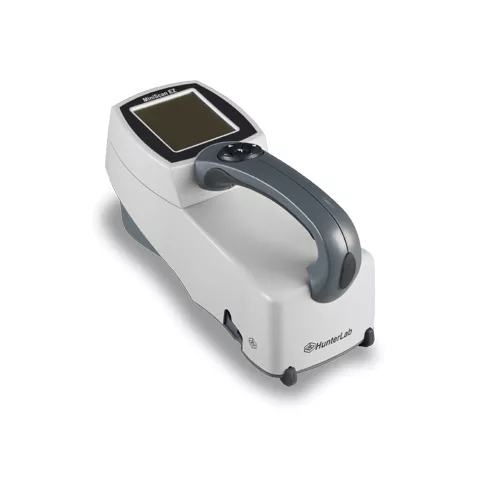
A Spectrophotometer Hunterlab MiniScan EZ 4000L is a portable, dual-beam spectrophotometer utilizing a diffuse/8° integrating sphere geometry with specular component included, delivering laboratory-grade color measurement on raw materials, finished goods, and irregular surfaces anywhere in the supply chain. This handheld instrument captures full spectral reflectance data from 400 nm to 700 nm in a single xenon flash, measuring a 20 mm view area within a 25.4 mm illuminated spot, and displays CIE L*a*b*, ΔE, and pass/fail results in under two seconds. It eliminates the need to cut samples for the lab bench, enabling incoming inspection at the loading dock, final QC on the production floor, and field evaluation at customer sites.
Key Features and Competitive Advantages of Spectrophotometer Hunterlab MiniScan EZ 4000L
The MiniScan EZ 4000L compresses Hunterlab’s full-size bench-top sphere technology into a rugged, one-handed portable form factor. Its integrating sphere design provides a decisive measurement advantage over directional 45°/0° handhelds when measuring textured, patterned, or directionally sensitive materials. The following capabilities define its operational value:
-
Diffuse/8° Sphere with Specular Included: The 63.5 mm integrating sphere illuminates the sample diffusely from all angles, then measures at 8° from the perpendicular. Including the specular component reads total color independent of surface texture or finish, making it the correct geometry for color-matching raw materials with varying gloss levels.
-
True Dual-Beam Optical System: An internal reference fiber monitors each xenon flash energy in real time, compensating for lamp output variation and ambient temperature drift. This eliminates the warm-up instability and repeated re-standardization cycles common to single-beam handhelds.
-
Single-Flash Measurement: A pulsed xenon lamp captures the entire 400-700 nm spectrum in one discharge. This minimizes sample heating on heat-sensitive materials like chocolate, wax, or thermoplastic pellets and enables measurement on vertical or inverted surfaces without liquid sample flow artifacts.
-
20 mm Measured Area (LAV): The large area view averages across 20 mm of the sample surface, bridging the gap between point-measurement handhelds and full-size lab instruments. Textured textiles, coarse mineral powders, and variegated plastic compounds yield representative readings without averaging multiple small spots.
-
Sub-2-Second Workflow: From trigger pull to displayed colorimetric data, the measurement cycle completes in under two seconds. At a 3-second minimum interval, operators can analyze a pallet of incoming resin lots or a rack of dyed fabric cuts without creating an inspection bottleneck.
-
> 1 Million Flash Lamp Life: The xenon source withstands over one million measurements. This equates to decades of daily inspection use without lamp module replacement or the spectral output degradation that triggers recalibration drift in LED-only portable instruments.
Technical Specifications and Selection Guide
Selecting a portable spectrophotometer demands careful evaluation of measurement geometry, port diameter, and the physical interaction between the sample surface and the instrument optics. The MiniScan EZ 4000L’s sphere-based design is purpose-built for samples that directional instruments cannot reliably characterize.
Spectrophotometer Hunterlab MiniScan EZ 4000L Technical Data
| Parameter | Specification |
|---|---|
| Measurement Principle | Dual-beam spectrophotometer/colorimeter |
| Measurement Geometry | Diffuse/8° (integrating sphere) |
| Specular Component | Included (total reflectance) |
| Sphere Diameter | 63.5 mm (2.5 in) |
| Illuminated Area (LAV) | 25.4 mm (1 in) |
| Measured Area (LAV) | 20.0 mm (0.8 in) |
| Spectral Engine | 256-element diode array; concave holographic grating |
| Spectral Range | 400 nm – 700 nm |
| Spectral Resolution | < 3 nm |
| Effective Bandwidth | 10 nm equivalent triangular |
| Reporting Interval | 10 nm |
| Photometric Range | 0 – 150 % reflectance |
| Light Source | Pulsed Xenon Lamp |
| Flashes per Measurement | 1 flash |
| Lamp Life | > 1,000,000 flashes |
| Measurement Time | < 1 second (trigger to measurement) |
| Display Update | 2 seconds (trigger to data display) |
| Minimum Measurement Interval | 3 seconds |
How to Choose Between Diffuse/8° Sphere and Directional Geometry
-
Textured or Patterned Samples: Select the MiniScan EZ 4000L with diffuse/8° sphere. Diffuse illumination from all angles eliminates directional sensitivity that causes 45°/0° instruments to read differently depending on how the operator orients the device over a woven fabric, brushed metal, or wood grain pattern.
-
Glossy or Semi-Glossy Surfaces: Select this instrument with specular component included (SCI). SCI mode measures total reflected light, capturing the true color regardless of gloss variations. This is critical when incoming plastic pellets from different suppliers possess different surface finishes but must mold into visually identical parts.
-
Pure Colorant or Pigment Powder: Select this instrument. The integrating sphere thoroughly illuminates irregular particle surfaces, and the 20 mm measurement area averages enough pigment particles to produce a representative reflectance curve without requiring a pressed pellet preparation.
-
Mirror-Finish or Wet Surfaces: Evaluate carefully. Specular included mode will capture the intense gloss spike, potentially saturating the detector. For these applications, consider whether specular-excluded or a dedicated directional geometry is more appropriate for the customer’s visual match criterion.
Who Should Use the Spectrophotometer Hunterlab MiniScan EZ 4000L?
This instrument addresses color control scenarios where bringing the sample to the stationary lab spectrophotometer is impractical, destructive, or time-inefficient. It extends laboratory-grade color science to the raw material warehouse, the molding machine hopper, and the fabric cutting table.
-
Plastics Compounders and Masterbatch Producers: Incoming resin acceptance at the loading dock requires immediate pass/fail decisions. The MiniScan EZ 4000L reads pellets poured into a sample cup, averaging the 20 mm view to account for pellet-to-pellet translucency variation and surface texture differences between suppliers.
-
Textile and Apparel Quality Control: Measure dyed fabric rolls, finished garments, and leather hides on the cutting table without cutting swatches for the lab. The diffuse sphere accurately reads corduroy, fleece, and napped fabrics whose apparent color changes with viewing direction under directional instruments.
-
Automotive Interior Component Inspection: Dashboard skins, carpet mats, and door panel inserts must match across tier-one suppliers. The portable sphere geometry evaluates color on the actual contoured part, not a flat molded plaque, capturing the true color as perceived inside the vehicle cabin.
-
Pharmaceutical Tablet and Capsule Production: Measure tablets and gel capsules directly in blister packs through the transparent film. The sphere illumination diffuses through the packaging without specular reflection artifacts, enabling 100% in-process visual verification against the approved color standard.
Best Way to Maintain and Operate the MiniScan EZ 4000L for Consistent Accuracy
Portable instruments face handling stress, environmental swings, and operator variability that stationary lab units avoid. Implementing rigorous daily procedures and proper measurement technique ensures the MiniScan EZ 4000L produces data directly traceable to the master lab instrument.
-
Daily Standardization Protocol: Standardize on the provided white calibration tile and check against the green check tile every shift. Record both values in a control chart. A trending green-tile ΔE drift exceeding 0.15 units indicates the white tile requires cleaning or the xenon lamp output has shifted beyond the dual-beam compensation range.
-
Sample Presentation Consistency: Always place the sample flat against the port plate with the sample holder boot attached. For powders and pellets, fill the sample cup to at least 10 mm depth and tap lightly to settle. Light leakage around the port edge artificially reduces reflectance and inflates the measured color saturation.
-
Integrating Sphere Interior Inspection: Monthly, remove the port plate and visually inspect the white sphere coating through the sample port. Any yellowing, dust accumulation, or coating delamination invalidates the diffuse illumination condition. Contact Hunterlab service immediately; field-cleaning the sphere coating destroys its Lambertian reflectance properties.
-
Battery and Data Integrity: Recharge only with the supplied lithium-ion pack. Remove the battery if the instrument will be stored longer than two weeks. Corroded battery terminals introduce resistance noise into the detector electronics ground plane, manifesting as erratic low-reflectance readings on dark samples.
-
Annual Factory Calibration: The holographic grating and diode array alignment must be verified against NIST-traceable spectral standards under controlled laboratory conditions. An annual factory recalibration service confirms wavelength accuracy, photometric linearity, and sphere coating integrity, and issues the certificate required for ISO 9001 and GMP audit compliance.
Frequently Asked Questions About Spectrophotometer Hunterlab MiniScan EZ 4000L
Why is diffuse/8° geometry better for textured samples than 45°/0°?
Diffuse sphere illumination bombards the sample from every angle, overwhelming surface texture shadows that directional instruments read as color differences. The 8° detection angle minimizes the specular spike while the 20 mm measurement area spatially averages woven, knitted, or embossed topography into one representative color value.
How to measure translucent or semi-transparent plastic parts?
Always back the sample with the supplied white calibration tile or a standardized opaque backing. The diffuse sphere captures light that transmits through the sample, reflects off the backing, and re-emerges. Changing the backing color changes the measured color; a standardized procedure is mandatory for supplier-customer agreement.
What is the best way to verify the MiniScan EZ 4000L against the lab spectrophotometer?
Read the same homogenous ceramic tile on both instruments within five minutes under identical temperature conditions. Compute ΔE using the same color scale and illuminant/observer combination. A ΔE under 0.30 indicates acceptable inter-instrument agreement; values exceeding 0.50 require a diagnostic service call.
Can the MiniScan EZ 4000L measure wet or sticky samples safely?
Place a clear, optically neutral film (such as a 40-micron polyester sheet) over the port plate before contacting the sample. Standardize through the film to subtract its transmittance signature. Never allow liquid or adhesive residue to contact the sphere interior; cleaning a contaminated integrating sphere requires factory re-coating.
Take Laboratory-Grade Color Control Anywhere in Your Supply Chain
The Hunterlab MiniScan EZ 4000L eliminates the compromise between portability and measurement fidelity. Its diffuse/8° integrating sphere, dual-beam stability, and one-flash xenon measurement provide the same colorimetric rigor expected from a benchtop spectrophotometer, executed on the receiving dock, on the production floor, or at the supplier’s facility. By measuring the actual product in its real physical state—textured, glossy, irregular, and un-cut—this system aligns incoming, in-process, and final color data to a single standard of truth.
Stop cutting samples to fit your instrument. Contact a Hunterlab portable instrumentation specialist to arrange a guided demonstration on your own most challenging textured or variegated product, and receive a detailed comparison report evaluating MiniScan EZ 4000L performance directly against your current lab spectrophotometer.
Reviews
There are no reviews yet.