


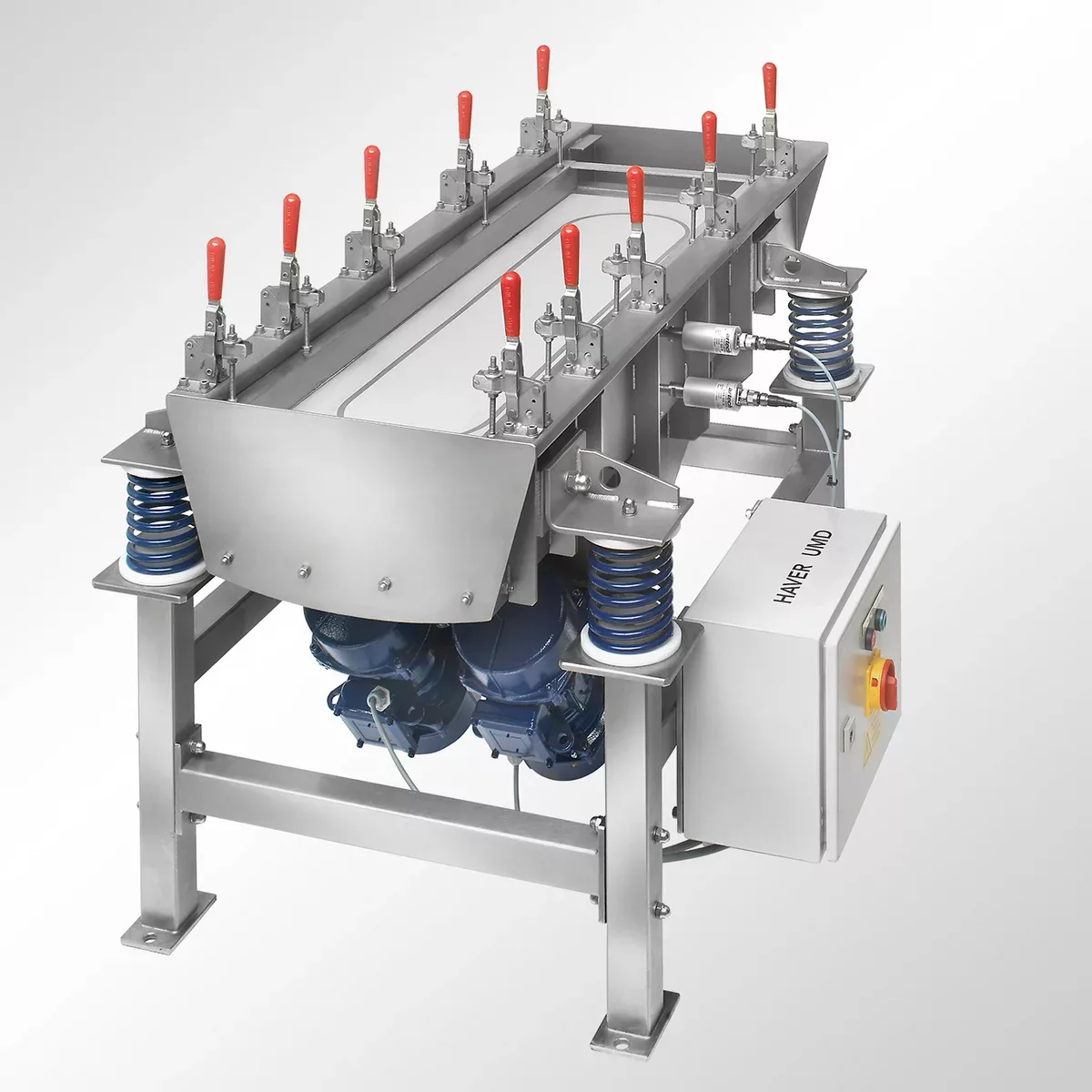
HAVER UMD Screening Machine: Heavy-Duty Particle Classification for Pilot Labs
A Screening Machines Haver UMD is an unbalanced-motor-driven, double-deck laboratory and pilot-scale sieve shaker built for dry classification of bulk solids from 100 µm up to 50 mm, generating three precise fractions in one operation. This robust floor-standing unit harnesses circular oscillation generated by twin rotating unbalanced masses to fluidize the sample bed, delivering high throughput for larger feed volumes that exceed the capacity limits of benchtop magnetic shakers. The system closes the gap between analytical lab devices and full-scale production screens, providing directly scalable separation data.
Key Features and Competitive Advantages of Screening Machines Haver UMD
The Haver UMD utilizes a time-tested unbalanced motor principle to produce a controlled three-dimensional throwing motion. The large screen format, significantly wider than benchtop alternatives, accepts representative sample splits of up to several kilograms, eliminating sub-sampling errors that plague smaller lab shakers. This capacity makes it indispensable for pilot plants and high-volume quality control.
-
Unbalanced Motor Drive: Twin counter-rotating weight shafts generate a high-energy circular vibration pattern. This robust, belt-free design handles bulk densities and particle weights that stall electromagnetic drives.
-
Extra-Large Screen Frame: The 1,250 mm x 400 mm screening surface doubles the usable area compared to smaller lab models, enabling continuous feed of quarry products, aggregates, and recycled materials.
-
Wide Particle Range (100 µm–50 mm): One machine covers the full spectrum from fine sands to coarse crushed stone. Three calibrated fractions exit simultaneously, quantified for gradation curves.
-
Pilot-Plant Scalability: The circular-throw motion directly models larger circular-motion production screens. Operating parameters like amplitude and throw angle translate linearly to site-scale equipment sizing decisions.
-
Robust Screening Aids: Active ball deck cleaning and high-frequency ultrasonic transducers prevent blinding of critical fine-mesh screens without process interruption.
-
Industrial-Grade Construction: Available in fully-welded stainless steel for corrosive mineral slurries, abrasive foundry sands, and sanitary fertilizer sampling environments.
Technical Specifications and Selection Guide
Pilot plants and industrial QC departments must match machine capacity, particle energy input, and material compatibility to the sample’s physical character. The Haver UMD’s unbalanced-motor system delivers adjustable centrifugal force to handle friable, dense, or oddly shaped particles.
HAVER UMD Technical Data
| Parameter | Specification |
|---|---|
| Screening Machine Model | HAVER UMD (Unbalanced Motor Drive) |
| Screen Frame Dimensions | 1,250 mm x 400 mm (L x W) |
| Particle Size Range | 100 µm to 50 mm |
| Machine Type | Double-deck (3 split cuts) |
| Screening Motion | Dry classification, circular oscillation |
| Drive System | Unbalanced motor (belt-free) |
| Screening Aids | Ball tray, Ultrasonic module option |
| Power Supply | 400 V line voltage (three-phase) |
| Material Construction | Regular steel / Stainless steel |
| External Dimensions (approx.) | 1,500 mm x 900 mm (L x W), variable height |
How to Choose Between the Haver UMD and Haver DMS
-
Sample Mass Over 2 kg: Select the UMD. Its larger screen area and higher motor power prevent pan accumulation and maintain cut-point sharpness under heavy bed depth.
-
Particles Exceeding 25 mm: Select the UMD. The 50 mm upper limit allows direct classification of coarse aggregates and crusher-run feeds that the smaller DMS cannot physically accept.
-
Production Screen Scale-Up: Select the UMD. Unbalanced-motor circular motion provides kinematic similarity to full-scale circular-throw quarry screens, making it the correct pilot tool for process engineers designing new plant screening circuits.
-
Bench-Space Constrained Lab: Re-evaluate your needs; the compact magnetic-drive DMS fits standard workbenches, whereas the floor-mounted UMD demands a dedicated 1.5 m x 0.9 m footprint with three-phase power access.
Who Should Use the Screening Machines Haver UMD?
The UMD targets environments where sample representativity and mechanical endurance outweigh the need for compact benchtop instrumentation. It serves as a process development workhorse, not just a final-check QC gauge.
-
Aggregate & Quarry Pilot Plants: Crushed stone, gravel, and recycled concrete asphalt (RCA) producers run full-bucket gradation analyses to dial in crusher closed-side settings multiple times daily without waiting for external lab results.
-
Mining Process Engineers: Mineral processing labs operating SAG mill cyclone overflow samples screen from 100 µm to 50 mm, modeling the entire plant circuit using a single standardized vibratory platform.
-
Foundry Sand Laboratories: Green sand and resin-coated sand operations demand high-energy sieving to break down agglomerated fines. The circular-throw UMD with stainless steel construction resists abrasive silica wear over multi-shift operation.
-
Fertilizer & Bulk Chemical QC: Granulated urea, potash, and ammonium nitrate producers require 400 V industrial power and optionally stainless steel contact parts for corrosive salt analysis, measuring crushing strength and size consistency simultaneously.
Best Way to Optimize Performance and Maintain the Haver UMD
A floor-standing unbalanced-motor shaker demands disciplined mechanical inspection and standardized sampling protocols. Operator skill in sample splitting, amplitude selection, and cleaning directly determines data reliability.
-
Unbalanced Weight Adjustment: Never adjust counterweight positions while the motor runs. Lock out the main disconnect, remove the access panel, and use a calibrated torque wrench to set identical eccentric angles on both shafts. Asymmetric weights cause destructive frame twisting.
-
Foundation Integrity: Bolt the machine rigidly to a 200 mm reinforced concrete inertia block isolated from the building floor. Unrestrained shakers walk across the floor, altering the throwing angle and shifting the apparent cut point.
-
Screen Tension Protocol: Use a dial-indicator tension gauge to verify center-screen deflection before every long-run test. A slack screen absorbs vibration energy and permits particle bouncing that sends fines into the oversize stream.
-
Ball Deck Lubrication-Free Operation: The ball tray requires no grease. However, inspect the perforated rubber ball mat every 200 hours for tears that trap sample material and harbor cross-contamination between batches.
-
Sampling Best Practice: Always use a rotary sample divider, not cone-and-quartering, to prepare the UMD feed aliquot. The large screen area demands a truly homogenous feed; segregation introduced during scoop-splitting magnifies into non-repeatable gradation curves.
Frequently Asked Questions About Screening Machines Haver UMD
Why does the UMD require 400 V three-phase power?
The unbalanced motor generates high centrifugal force for classifying dense, coarse particles up to 50 mm. This torque demand exceeds single-phase current limits and requires a 400 V industrial supply for stable, continuous oscillation.
How to feed the UMD correctly for reproducible results?
Use a vibratory feeder or a wide-mouth scoop to distribute material evenly across the full 1,250 mm feed-end width. Dumping a single pile in the center starves the screen edges and reduces effective classification area.
What screening aid works best for clay-contaminated aggregates?
Start with the ball tray system. The rubber ball impacts break the capillary-bound clay bridges agglomerating fines. If the minus-200-mesh cut remains sticky, activate the ultrasonic generator on the lower deck only to avoid destroying friable aggregate particles.
Can the UMD perform wet screening?
The standard Haver UMD is designed for dry classification with an unbalanced motor. Wet screening requires a sealed stainless steel housing, slurry distribution headers, and a sump outlet, modifications typically specified at the factory rather than as a field retrofit.
Scale Your Particle Analysis from Lab to Production
The Haver UMD screening machine bridges the critical gap between analytical laboratory testing and full-scale industrial screening. Its unbalanced-motor drive, large-format double deck, and 50 mm upper particle limit provide the representative, scalable data required to commission new plants and troubleshoot existing circuits. When sample integrity, throughput, and direct kinematic correlation to production screens define your success criteria, the UMD is the correct platform.
Stop guessing at production screen performance. Contact a Haver & Boecker process engineering specialist to schedule a screening trial with your bulk material, and receive a detailed scale-up report correlating UMD pilot data directly to your proposed plant equipment specifications.
Reviews
There are no reviews yet.