


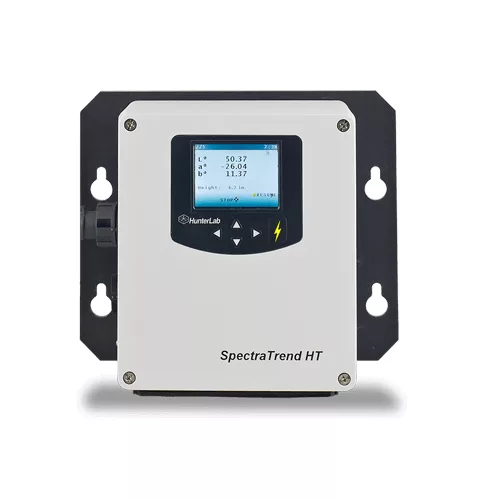
Spectrophotometer Hunterlab SpectraTrend HT: Real-Time, In-Process Color Control
A Spectrophotometer Hunterlab SpectraTrend HT is a dual-beam, in-line/in-process spectrophotometer designed for non-contact, continuous color measurement of moving product streams on manufacturing conveyors, delivering full spectral data from 400 nm to 700 nm every second with 0°/30° measurement geometry and specular component exclusion. Unlike laboratory bench-top instruments that require manual grab sampling, this system mounts directly above the production line, measuring product at a typical working distance of 63.5 mm to 140 mm and converting raw spectral reflectance into actionable colorimetric values (CIE L*a*b*, ΔE) for closed-loop process control or immediate reject sorting.
Key Features and Competitive Advantages of Spectrophotometer Hunterlab SpectraTrend HT
The SpectraTrend HT replaces subjective visual inspection and slow offline lab testing with automated, objective, high-frequency color data. Its sealed optical architecture and solid-state LED illumination system are engineered to survive the dust, vibration, and ambient light interference common in food processing, plastic extrusion, and building product manufacturing. The system provides distinct process advantages:
-
Dual-Beam Real-Time Compensation: An internal reference channel corrects each flash for LED intensity drift, ambient temperature shifts, and electrical noise, ensuring stable baseline readings without hourly re-calibration against external tiles.
-
Non-Contact 0°/30° Geometry: Measures color the way the human eye perceives it, while excluding the specular gloss component. This prevents glossy snack foods, painted metal coil, or vinyl siding from reading incorrectly dark or saturated due to surface shine.
-
High-Speed Spectral Acquisition: A 256-element diode array with a concave holographic grating captures the full 400-700 nm spectrum from 5-6 LED flashes per measurement. At a 1-second minimum interval, the system identifies short-term color drift caused by mixer segregation, temperature cycling, or ingredient feed blockages before out-of-spec material accumulates.
-
Sealed, Process-Ready Optics: Positive-pressure purge fittings and gasketed optical compartments prevent airborne powders, coating overspray, and plastic pellet fines from fogging the sensor window or contaminating the grating, enabling reliable operation without daily lens cleaning.
-
Height-Tolerant Measurement: A 25.4 mm view diameter maintained across a 63.5 mm to 140 mm working range accommodates varying product bed depths, textured surfaces, and conveyor belt flutter without re-focusing or losing area-averaging integrity.
-
5-Year Typical LED Life: The full-spectrum solid-state illuminator eliminates lamp replacement inventory and periodic recalibration downtime associated with pulsed-xenon flash lamps, lowering the total cost of ownership in 24/7 production environments.
Technical Specifications and Selection Guide
Integrating an in-line spectrophotometer requires precise matching of measurement geometry, working distance, and data interface to the production line’s mechanical constraints. The SpectraTrend HT mounts on a rigid stand or custom bracket with height resolution of 1 mm to optimize the view spot positioning over textured or profiled products.
Spectrophotometer Hunterlab SpectraTrend HT Technical Data
| Parameter | Specification |
|---|---|
| Measurement Principle | Dual-beam in-line/in-process spectrophotometer or colorimeter |
| Measurement Geometry | 0°/30° (illumination/detection) typical |
| Specular Component | Excluded (color as visually perceived) |
| Spectral Engine | Sealed optics; 256-element diode array; concave holographic grating |
| Spectral Range | 400 nm – 700 nm |
| Spectral Resolution | < 3 nm |
| Effective Bandwidth | 10 nm equivalent triangular |
| Reporting Interval | 10 nm |
| Photometric Range | 0 – 150 % reflectance |
| Light Source | Full spectrum, balanced solid-state LED system |
| Flashes per Measurement | 5–6 flashes averaged |
| Lamp Life | 5 years typical (continuous use) |
| Minimum Measurement Interval | 1 second |
| View Diameter | 25.4 mm (1 in) at 82.55 mm (3.25 in) standoff |
| Working Range (Height) | 63.5 mm – 140 mm (2.5 in – 5.5 in) |
| Height Resolution | 1 mm (0.1 in) |
How to Position the SpectraTrend HT for Optimal Measurement Accuracy
-
Fixed Working Distance: Set the sensor face precisely perpendicular to the average product plane. Use the 1 mm height resolution adjustment to lock the standoff distance, ensuring the 25.4 mm view spot fully lands on product rather than conveyor belt background.
-
Ambient Light Exclusion: Mount flexible rubber shrouds or dark curtains around the measurement zone. Although the LED system is intense, direct sunlight from overhead skylights or inspection lamp glare introduces a non-constant offset error.
-
Specular Component Management: The 0°/30° geometry inherently excludes gloss. Never tilt the sensor off-axis to avoid gloss; this changes effective path length and violates the instrument’s designed optical geometry, corrupting the CIE color calculation.
-
Target Averaging for Textured Products: For granola, wood chips, or multi-color plastic regrind, program the instrument to average 10-20 sequential 1-second measurements. This spatial averaging produces a single representative color vector that correlates with the human impression of a blended product stream.
Who Should Use the Spectrophotometer Hunterlab SpectraTrend HT?
This instrument serves manufacturers who need to replace post-production lab rejections with real-time process intervention. It is not a QC documentation tool that measures retained samples; it is an active process control sensor.
-
Extruded Snack & Cereal Manufacturers: Measure color directly on the vibratory conveyor exiting the fryer or oven. Immediate color feedback controls dwell time and oil temperature, preventing cartons of over-browned product from leaving the packaging line.
-
Vinyl Siding & Engineered Stone Producers: Continuous coil-coated metal and PVC siding color must remain consistent across production runs spanning months. The SpectraTrend HT mounted post-embossing detects color shift from pigment metering errors before the material is cut to length.
-
Carpet and Textile Mills: Measure dyed carpet tufting or denim warp yarns online. The high-speed sampling identifies dye bath exhaustion drift within a single roll, enabling SPC alarming directly to the dye kitchen dosing system.
-
Industrial Powder Coatings: Monitor the color of free-falling powder in pneumatic conveying lines by installing the sensor behind a sapphire window. Detecting overspray cross-contamination immediately prevents coating entire batches in a subtly wrong shade.
Best Way to Maintain and Operate the SpectraTrend HT for Reliable Data
An in-line spectrophotometer operates in a harsh environment. Proactive optical hygiene and disciplined calibration transfer protocols are essential for converting raw spectral data into trustworthy pass/fail decisions that align with the QA laboratory master instrument.
-
Sensor Window Cleaning Protocol: Inspect the sapphire window at shift change. Use an optical-grade microfiber cloth dampened with isopropyl alcohol. Never use compressed air that embeds abrasive dust into the glass or a dry rag that microscopically scratches the anti-reflection coating.
-
Instrument Profiling to the Lab Master: Establish a correlation file using 20-30 production samples read on both the lab benchtop spectrophotometer and the in-line SpectraTrend HT. Apply a linear regression bias correction inside the software, not by altering the instrument’s raw calibration, to ensure plant-floor decisions align with certificate-of-analysis values.
-
Environmental Protection: Maintain 0.5–1.0 bar positive air purge through the optical housing fittings to prevent dust ingression. If ambient temperature swings exceed 15 °C, enable the internal temperature compensation algorithm, which corrects dark current drift at the diode array level.
-
Annual Factory Recertification: Return the sensor to Hunterlab or an ISO 17025 accredited lab for spectral wavelength linearity and photometric accuracy verification using calibrated ceramic tiles and didymium filters. Field recalibration via a single white tile cannot detect grating misalignment or detector nonlinearity developing over time.
Frequently Asked Questions About Spectrophotometer Hunterlab SpectraTrend HT
Why exclude the specular component in an in-line measurement?
Excluding gloss ensures the instrument mimics human perception, reading only the body color and not the surface shine. This prevents glossy products from falsely appearing too dark and eliminates process engineers making unnecessary corrective changes based on surface reflectance artifacts.
How to correlate in-line readings to the lab benchtop instrument?
Measure identical physical samples on both devices, then compute a linear correction matrix (additive/subtractive bias, not multiplicative) in the software. This accounts for systematic differences in geometry, illumination, and viewing without invalidating the factory spectral calibration of either instrument.
What is the best way to measure irregularly shaped or textured products?
Increase the measurement averaging count to 20-30 consecutive readings per data output, and ensure the 25.4 mm view spot captures multiple representative texture peaks and valleys. The sensor height tolerance permits mild product height variation without signal clipping or spot-size collapse.
Can the SpectraTrend HT withstand dusty or washdown environments?
The sealed optics and positive-pressure purge fittings protect the internal grating and diode array. The enclosure is IP-rated for dry production environments; however, direct high-pressure washdown requires a supplementary stainless steel enclosure with a laminated glass optical port.
Automate Color Decisions with In-Line Spectral Data
The Hunterlab SpectraTrend HT converts the production line itself into a real-time quality control instrument. By replacing lagging lab readings with continuous, geometrically correct color data updated every second, this system empowers operators to adjust processes before limits are breached and prevents off-color inventory from reaching customers. Its dual-beam stability, sealed solid-state optics, and direct 0°/30° correlation to the human visual experience address the root cause of color variability: delayed measurement feedback loops.
Stop relying on post-production sampling. Contact a Hunterlab applications engineer today to rent a SpectraTrend HT for an on-site feasibility study running your actual product, and receive a detailed correlation report showing exactly how much process variation your current lab-only QC program is missing.
Reviews
There are no reviews yet.